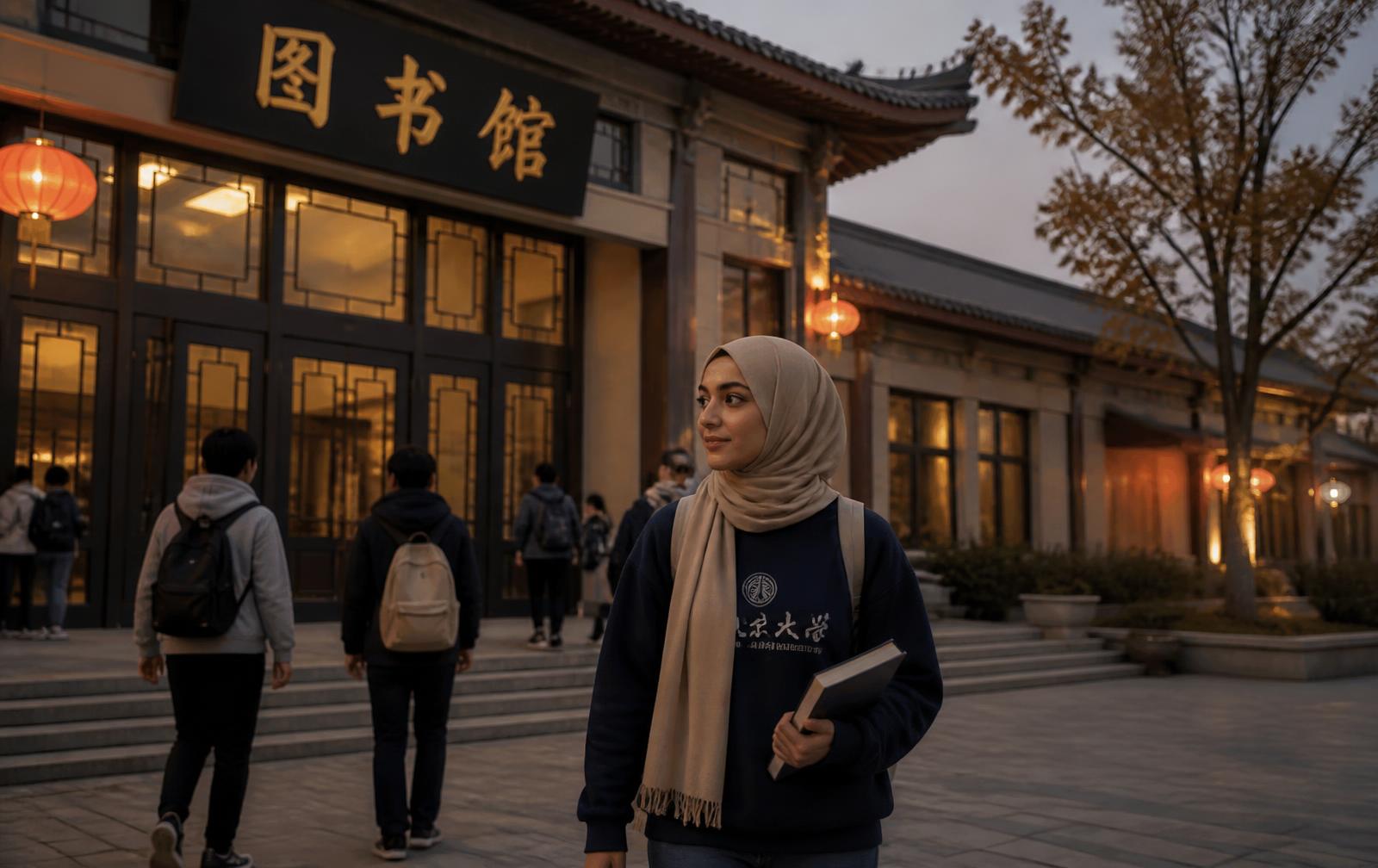
I met Amira Farouk in a downtown Cairo cafe three blocks from Tahrir Square, the kind of place where the waiters know which customers are grading papers and refill their coffee without being asked. She was twenty-six, finishing a master's in international relations, and had just returned from two years at Fudan University in Shanghai on a Chinese Government Scholarship.
She spoke Mandarin with the ease of someone who had dreamed in it for a while, and she spoke about China the way a person speaks about a mentor rather than a benefactor, with affection, but also with a clear-eyed sense of what the mentor wanted from the relationship. "Nobody in Shanghai ever told me what to think," she said. "They just made sure I was the one in the room when the thinking happened." I have not stopped turning that sentence over since.
It is, I would argue, the most precise description available of what Chinese scholarships have become across the Global South: not indoctrination, which is a clumsy word for a subtle instrument, but presence and access. The quiet, compounding advantage of being the government that paid for the plane ticket, the tuition, the accommodation, and the stipend, at a moment when Western scholarship budgets were shrinking, and Chinese ones were expanding. African enrollment in China peaked at 81,562 students in 2018, the last year Beijing published a clean official count, before the pandemic border closures cut the numbers by more than half; by the 2024-25 academic year, African students had recovered to roughly 61,500, still about sixteen percent of all foreign students in the country. Cairo University, Ain Shams University, and Suez Canal University now each house a Confucius Institute, feeding a pipeline of Chinese-language learners who graduate not merely fluent, but fluent in the vocabulary of a very particular worldview.
The scholarship architecture itself is more layered than most coverage suggests, and the layering is deliberate. The China Scholarship Council administers a Bilateral Program, negotiated government-to-government and channeled through Egypt's own Ministry of Higher Education, alongside a University Program that lets individual Chinese institutions recruit graduate students directly, bypassing state intermediaries altogether. Then there is the so-called Silk Road, or Belt and Road, scholarship track, a looser label that dozens of Chinese universities and provincial governments now attach to funding earmarked specifically for citizens of Belt and Road Initiative partner countries, Egypt prominently among them since Cairo signed on in 2016. Layered atop all three sits the Confucius Institute Scholarship, narrower in scope, language-and-culture focused, but often the first rung on the ladder for an Egyptian eighteen-year-old who has never left the Nile Delta. Each track has a different gatekeeper, a different bureaucracy, a different level of Beijing's fingerprints on the selection process. Together, they form something closer to an ecosystem than a program, one built to catch a student at almost any point in their trajectory and walk them, fully funded, into a Chinese classroom.
At the 2024 Forum on China-Africa Cooperation (FOCAC) in Beijing, President Xi Jinping pledged sixty thousand new scholarships and training opportunities for African citizens over the following three years, alongside training slots for six thousand military officers and one thousand police personnel, and an invitation for one thousand African political-party members to study governance and party administration inside China. I want to resist the easy cynicism of reading that package as pure manipulation, because plenty of it answers a real and urgent need: African universities are overcrowded, underfunded, and producing far more qualified applicants than they have seats or laboratories to serve. But I want to resist, with equal firmness, the naivety of reading it as pure generosity. A government does not fund the graduate education of a foreign country's future central bank governors, telecom regulators, and army colonels because it has grown sentimental about human capital. It does so because it has done the arithmetic on where influence compounds fastest, and concluded that it compounds in the mind of a twenty-two-year-old before it compounds anywhere else.
This is the part of the story that rarely survives translation into a press release, and it is the part I find most intellectually honest to sit with. Soft power of this kind is not measured in the moment of the scholarship, but in the decade after it. The Egyptian engineer who studied high-speed rail systems at Southwest Jiaotong University does not return home and lobby for Chinese contracts out of loyalty; she returns home as the most qualified person in the room to evaluate those contracts, trained in Chinese technical standards, fluent in Chinese engineering vocabulary, and instinctively inclined to recommend the systems she actually understands. Multiply her by the tens of thousands of Global South alumni now scattered through African and Asian ministries of finance, transport, telecommunications, and defense, and you have something considerably more durable than a treaty: an entire professional class whose formative expertise was built, quite literally, in Mandarin.
Beijing has also been unusually candid, in its own domestic discourse, about why this matters. Xi Jinping's 2013 directive to "tell China's story well" was aimed initially at state media, but it has since extended, in practice if not in formal doctrine, into education diplomacy, cultural centers, and the training of foreign journalists and civil servants who will one day describe China to their own publics. The FOCAC 2024 outcome document explicitly folded media cooperation and scholarship expansion into the same strategic basket, a pairing that should not surprise anyone who has watched how consistently China frames education as a component of what it calls, in its own language, comprehensive national power. None of this makes the scholarships worthless to the students who win them. It makes them exactly what any honest observer should expect a great power's education diplomacy to be: generous, genuinely transformative for the individual, and never, at any point, disinterested.
There is also a harder, less flattering layer beneath the achievement stories, and I would be doing my readers a disservice to leave it out. Degree recognition remains uneven; some Egyptian graduates of Chinese universities describe a frustrating gap between their credentials and how domestic employers value them, particularly outside engineering and the hard sciences. English-medium instruction, now standard at China's better institutions, has quietly narrowed the incentive to learn Mandarin at all, which undercuts the very cultural-fluency goal the scholarships were designed to produce. The scale itself invites scrutiny: FOCAC's own scholarship pledges have historically lacked the kind of transparent, independently audited reporting that would let anyone outside Beijing verify how many of the sixty thousand promised places actually materialize, who receives them, and on what selection criteria. Africa Center for Strategic Studies researchers have made this point about the broader FOCAC financing pledges, and there is no reason to believe the education commitments are held to a different standard of disclosure.
I keep returning to Amira, and to a dozen students like her I have interviewed across Cairo, Alexandria, and Rabat over the past two years, because their calculus is not academic; it is existential. Western scholarship pipelines, Fulbright among them, have grown more selective and, in the American case, more politically precarious, just as Washington's 2025 restructuring of its foreign-assistance architecture eliminated or shrank a range of education-adjacent programs that Global South students had relied on for a generation. Into that vacuum, China did not need to argue that its system was superior. It only needed to keep the application portal open, keep the tuition free, and keep the flights subsidized, while everyone else debated budgets. This year, 2026, marks the seventieth anniversary of diplomatic relations between Cairo and Beijing, and Egyptian officials have made little secret of the fact that education cooperation, alongside the Suez Canal Economic Zone and the New Administrative Capital's Chinese-financed skyline, will anchor the commemorations. The symbolism is not incidental. It is the argument, made in stone and scholarship certificates rather than speeches.
What, then, is the endgame, if there is a single one to name? I do not think it is control, in the crude sense that word implies, and I am suspicious of analysts who reach for it because it flatters a simpler story than the one actually unfolding. I think the endgame is optionality: a Beijing that, twenty years from now, can point to finance ministers in Accra, telecom regulators in Cairo, infrastructure planners in Addis Ababa, railway engineers in Nairobi, mining regulators in Windhoek, energy planners in Lusaka, and diplomats in Rabat who studied in Chinese classrooms, speak some Mandarin, understand Chinese negotiating norms from the inside, and default, when a contract or a vote or a partnership is on the table, to giving China the benefit of the doubt that familiarity provides. That is not indoctrination. It is something more patient and, frankly, more effective: the slow, generational construction of a shared professional vocabulary between China and the Global South, built one scholarship, one dormitory room, one Confucius Institute at a time, while the rest of the world was still deciding whether to renew its own.
Amira is applying for a doctoral fellowship now, this time in Beijing, at a university she declines to name until the funding letter arrives. I asked her, before we finished our coffee, whether she thought of herself as part of someone else's strategy. She smiled, the particular smile of someone who has read the analyst's writing about her and finds them only half right. "Everyone who ever paid for my education wanted something," she said. "The difference is China actually showed up." I have not found a better one-sentence summary of the entire arrangement, from either side of it, since.
This research briefing is published by Veritas Global Advisory's editorial desks. Views expressed are those of the authors and do not constitute investment advice.