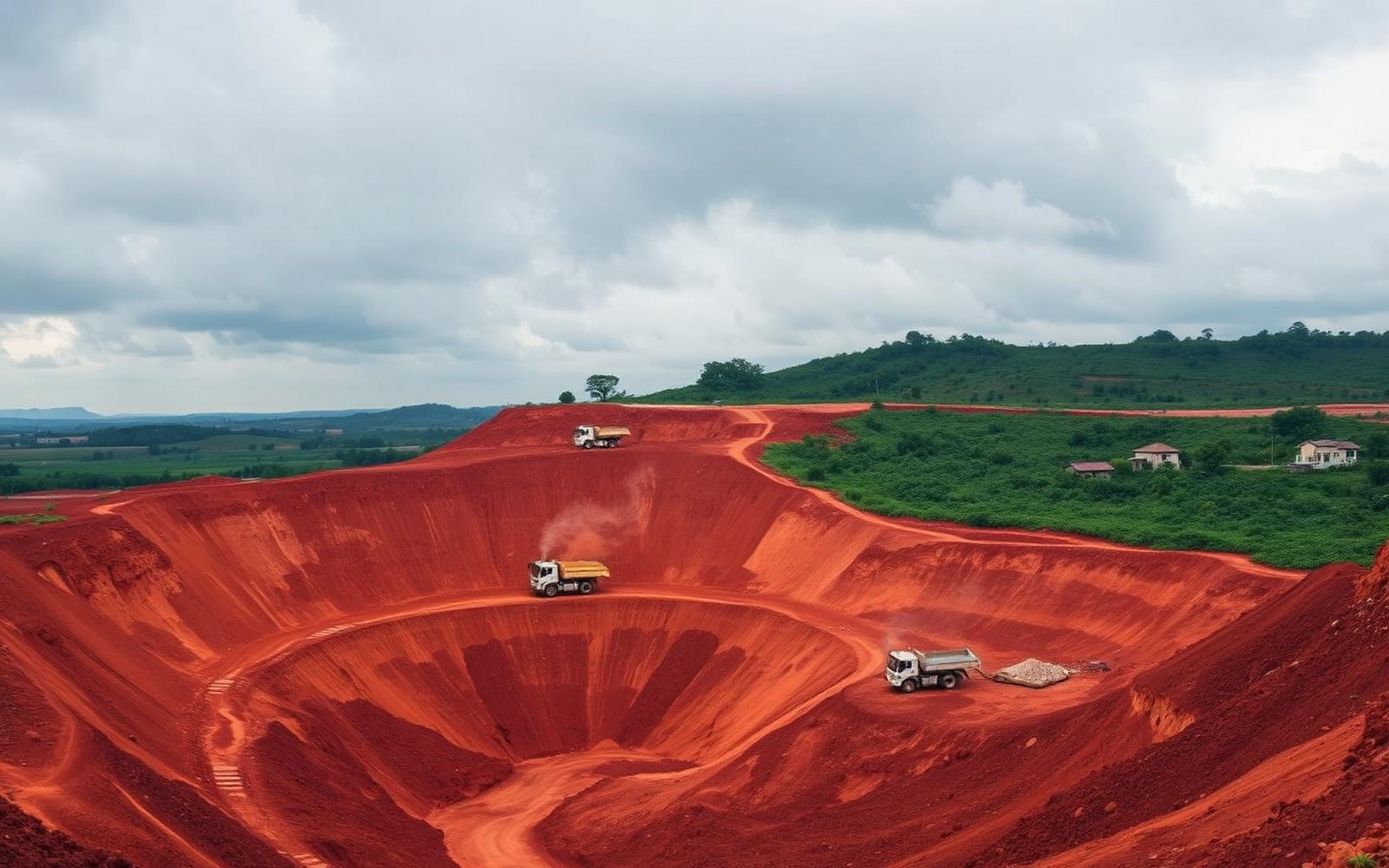
I have sat through enough village meetings in the Central Region to know the sound a community makes when it stops trusting a promise. It is not shouting. It is a particular, patient quiet, the kind farmers in Ewoyaa and the surrounding cocoa-and-cassava towns wore on their faces for much of last year, as survey trucks rolled past their farms toward pegmatite deposits nobody there had heard of a decade earlier. That quiet has since given way to something louder: parliamentary debate, newspaper editorials, and a genuine argument, running from Accra's chop bars to its Stock Exchange floor, about who Ghana's lithium actually belongs to. I would argue it is the most consequential economic story West Africa has produced this year, more consequential, in its way, than any single election, because it will determine the terms on which every mineral-rich country from Guinea to Niger negotiates its future.
The facts, stripped of their politics, are these. In March 2026, Ghana's Parliament ratified the mining lease for the Ewoyaa Lithium Project, the country's first, sitting atop a resource of roughly 36.8 million tonnes of ore at 1.24 percent lithium oxide, enough to make Ghana a genuine, if modest, entrant into the global battery-metals trade. The ratification replaced a flat royalty with a sliding scale tied to spodumene prices. This technocratic detail mattered enormously to a Ministry of Finance trying to avoid the fixed-royalty mistakes of Ghana's gold sector. Half of Ewoyaa's planned output was already committed under an offtake agreement to Elevra Lithium, the Piedmont-Sayona merger with prior supply ties to Tesla and LG Chem, meaning that, on paper, Ghana had positioned itself as Africa's only lithium project with a credible line into American and Korean battery supply chains. It was, briefly, a tidy story: African ore, Western capital, a seat at the electric-vehicle table that Africa has mostly watched from the parking lot.
Then, in May, Zhejiang Huayou Cobalt, one of the handful of Chinese firms that, between them, refine the overwhelming majority of the world's battery-grade lithium, nickel, and cobalt, offered $210 million for Atlantic Lithium outright, the Australian-listed operator that holds the license. Within days, Huayou had also agreed to fund Ewoyaa's remaining development costs regardless of whether the full acquisition closed, effectively guaranteeing itself a seat at the table whatever Atlantic Lithium's shareholders decided. Ghanaian commentators, myself included, watched a project that had been sold to the public as a diversification away from raw-ore dependency suddenly reopen the oldest question in African resource politics: does discovery change who holds the leverage, or does it merely change who is asking to buy it?
I do not think this is a story about villains. It is tempting, writing from Accra, to reach for the easy frame that China is 'grabbing' African lithium the way an earlier generation of commentators said European firms grabbed African gold and cocoa. That frame flatters our sense of grievance but flattens the actual arithmetic. Huayou is not circling Ewoyaa because it is cunning; it is circling Ewoyaa because it is one of perhaps four companies on earth with the refining capacity, the offtake relationships, and the balance sheet to turn spodumene concentrate into the lithium hydroxide that actually goes into a battery. Ghana's own Minerals Commission has said as much, quietly, in briefings I have sat through. There is presently no serious Western consortium prepared to build the midstream processing capacity Ghana would need to avoid exporting raw rock and re-importing it as a finished battery. China built that capacity over two decades of state-directed industrial policy that neither Washington nor Brussels ever chose to match at comparable scale. Ghana is not being outmaneuvered by Chinese cleverness. It is discovering the consequences of a global processing map that was drawn without it in the room.
What makes this genuinely necessary, not merely interesting, for West Africa to confront now is the timing. The African Continental Free Trade Area is five years into operational trade and still searching for a manufacturing base that would allow African states to capture value beyond the mine gate. The Sahel has spent the same five years drifting from Western security partnerships toward Russian and, increasingly, Chinese commercial ones. Guinea's bauxite exports to China now anchor an entire alumina-and-aluminum ambition in Boke that Conakry could not have financed alone. And the International Energy Agency's own projections point to a lithium supply deficit approaching 40 percent by the mid-2030s, even after accounting for the current price trough that has made Ewoyaa's economics so politically fraught this year. Ghana is not negotiating a single mining lease. It is setting a precedent for how an entire region - Cote d'Ivoire, where Atlantic Lithium holds a further 771 square kilometers of licenses; Mali, where Chinese-linked lithium operations have already drawn scrutiny over export practices; Nigeria, quietly exploring its own spodumene occurrences in Nasarawa - will structure the next decade of critical-mineral bargains.
The Natural Resource Governance Institute's public questioning of Atlantic Lithium's revised internal rate of return, and the Ghana Extractive Industries Transparency Initiative's insistence on public disclosure of the Huayou financing terms, are not obstructionism. They are, I would suggest, exactly the kind of institutional friction a country needs when it discovers that its bargaining position depends on when a Chinese state-linked buyer decides a Western junior miner is undervalued. Ghana's Minerals Income Investment Fund holding a free-carry equity stake, and a Ghanaian pension fund's roughly $11 million direct investment in Atlantic Lithium's most recent funding round, both point toward a government that has learned, from cocoa, from gold, from three decades of IMF programs, that ownership structure matters as much as royalty rate. Whether that lesson holds once construction begins and the political pressure to simply get the mine built overwhelms the pressure to get the terms right is the question I intend to keep asking.
There is also a quieter, more human dimension that rarely survives translation into a briefing note. The farmers around Ewoyaa are not weighing geopolitics. They are weighing compensation schedules, resettlement timelines, and whether the jobs promised at the DMS processing plant will go to their sons or to contractors bused in from Accra. China's presence in that calculation is abstract to them in a way it is not to a minister in Accra fielding calls from Beijing and Washington in the same week. My own view, shaped by too many of those village meetings, is that the country that gets this right will not be the one that picks a geopolitical side, but the one that builds the domestic regulatory muscle - transparent royalty formulas, enforceable local-content rules, genuinely independent parliamentary scrutiny - to extract fair terms from whichever capital shows up first, Chinese, American, or otherwise. That muscle, more than any single deposit, is what West Africa actually needs right now. Lithium will be depleted in fifteen years. The institutions built to bargain over it, if built well, will outlast the mine.
Veritas Global Advisory's Africa Watch desk continues to track the Ewoyaa transaction through to Atlantic Lithium's shareholder vote and Ghana's final investment decision, alongside parallel critical-minerals negotiations in Guinea, Cote d'Ivoire, and the Democratic Republic of Congo. A forthcoming briefing will examine how the AfCFTA's Protocol on Investment could be used to standardize minimum local-ownership and beneficiation terms across West African critical-mineral leases - the regional answer, if there is to be one, to the bilateral bargaining that has defined the sector until now.
This research briefing reflects the views of the author and Veritas Global Advisory's editorial desks. It does not constitute investment advice.
This research briefing is published by Veritas Global Advisory's editorial desks. Views expressed are those of the authors and do not constitute investment advice.