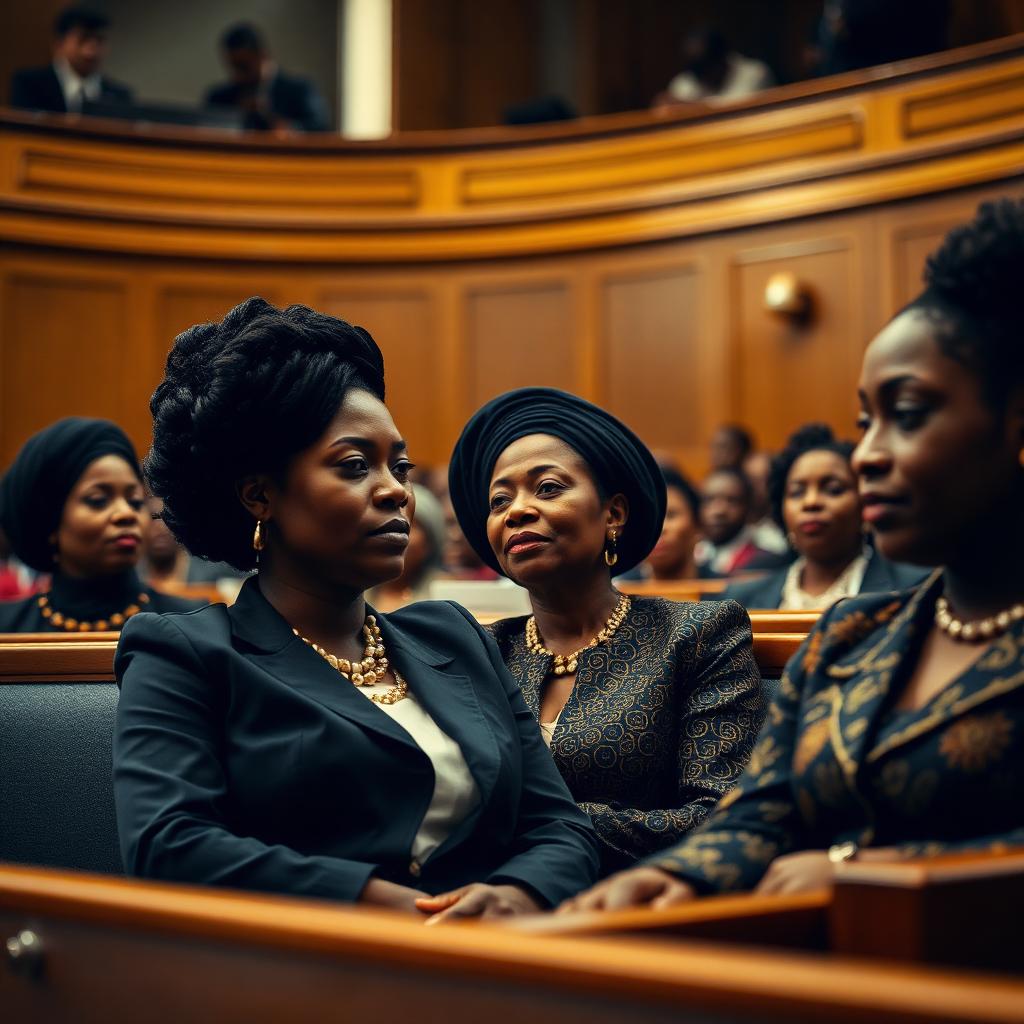
On the morning of 21 March 2025, Ester Kavendjii closed her small tuck shop on Independence Avenue for exactly forty minutes, propped a borrowed television on an upturned crate, and watched Netumbo Nandi-Ndaitwah take the presidential oath at State House in Auasblick, Windhoek, the ceremony having been moved from Independence Stadium due to heavy rains. Ester is fifty-one, sells airtime and cold drinks to civil servants on their lunch break, and has voted in every Namibian election since 1994. She did not cry, she told me later, because she is "not a crying person" but she admitted to standing very still for the part where Lucia Witbooi was sworn in beside the new president as Namibia's first female vice president. "I have sold sweets to men in suits my whole life," she said. "That day I watched two women become the suits."
It is a small, almost domestic image to hang a continental argument on, and I have chosen it deliberately, because the story of women's rise to power in Africa is too often told entirely from the podium and never from the tuck shop. Namibia's cabinet is now half female by design, not by accident of arithmetic, and the country has, in effect, assembled the most gender-balanced executive branch on the continent. The African Commission on Human and Peoples' Rights called it the most significant advance in African women's political leadership since the continent adopted the Maputo Protocol in 2003, the treaty that first bound African Union member states, on paper at least, to gender parity in decision-making. Twenty-two years is a long time between a promise on paper and a cabinet room that actually looks like the promise.
Namibia is not an isolated data point; it is the most recent, and arguably the most complete, expression of a pattern that has been assembling itself across the continent for two decades. Ellen Johnson Sirleaf became Africa's first democratically elected female head of state when she was inaugurated as Liberia's president in 2006. A Harvard-trained economist, she inherited a country still recovering from civil war and left office fourteen years later after overseeing Liberia's first peaceful democratic transfer of power in decades. Joyce Banda became Malawi's president in 2012, Ameenah Gurib-Fakim, a biodiversity scientist, became Mauritius's first female president in 2015, Sahle-Work Zewde assumed Ethiopia's presidency in 2018; and Samia Suluhu Hassan became Tanzania's president in March 2021 following the death of John Magufuli, before later winning election to a full term. In the Democratic Republic of Congo, economist Judith Suminwa Tuluka became the country's first female prime minister in 2024, taking office in one of Africa's most complex political environments. By recent estimates, more than twenty African women have served as their country's highest political leader through election, appointment, or constitutional succession, a gradual but unmistakable shift in the continent's political landscape.
The line extends beyond the presidency, too, and this is the part of the story that analysts obsessed with heads of state routinely miss. Rwanda's parliament has held the world's highest share of women in a national legislature for the better part of two decades, comfortably above sixty percent in its lower house, a fact so consistently true that international observers have stopped treating it as remarkable, which is itself remarkable. In the private sector, Mary Vilakazi's ascent to chief executive of South Africa's FirstRand Group has placed her at the top of Forbes' 2025 ranking of African women on its list of the world's most powerful women. She ranked 74th globally, ahead of DRC Prime Minister Judith Suminwa Tuluka at 78th and Namibian President Netumbo Nandi-Ndaitwah at 79th. Power, in other words, is not reaching African women through a single door marked "presidency." It is increasingly visible across government, finance and business, from political leadership to major financial institutions and corporate boardrooms. That breadth matters: it suggests that women's growing presence at the apex of African institutions is becoming more than a collection of individual breakthroughs and may be evidence of a broader structural shift.
I want to resist, here, the easy temptation to write this as a fairy tale, because the women who have actually lived it would be the first to correct me. The path to these offices has rarely run through open contest on equal terms. Sirleaf, Banda, Hassan, and Nandi-Ndaitwah all spent decades inside the machinery of male-dominated liberation movements and ruling parties before their moment arrived, which means the "rise of women" in African politics has, so far, mostly been the rise of women who first proved themselves indispensable within structures built by and for men. Female candidates across the region continue to report harsher media scrutiny of their appearance and family life than their male counterparts face, thinner campaign war chests, and, increasingly, coordinated harassment on the same social media platforms that are supposed to democratize political participation. Globally, women still hold fewer than one in five parliamentary speakerships, a statistic that should discipline anyone tempted to declare victory prematurely. And there remains the quieter risk that a gender-balanced cabinet photograph is mistaken for gender-balanced power, when the finance and defense portfolios, more often than social ministries, still tend to fall into male hands.
I have spent the better part of two years traveling between Windhoek, Gaborone, Lusaka, and Harare for this publication, sitting through budget debates and by-election counts. What strikes me most is not the ceiling these women have broken, but the style of leadership several of them have brought through it. Nandi-Ndaitwah's first year in office has been defined less by dramatic rupture than by an almost stubborn insistence on institutional continuity, debt stabilization, and quiet coalition-building among Namibia's fractious opposition benches, a governing temperament that a generation of male predecessors across the region rarely bothered to cultivate because they did not need to. Hassan's Tanzania has reopened space for independent media that had been suffocated for years. These are not universal feminine traits, and I distrust any argument that essentializes them as such. However, they are observable patterns in how a specific cohort of women, shaped by having to outwork and outlast their way into rooms that were not built for them, have chosen to govern once they arrived: consultative rather than performative, patient rather than combustible, oriented toward the slow infrastructure of institutions rather than the fast theater of the strongman.
That, I think, is the real argument for why this matters far beyond Africa's borders. The continent has spent much of the past decade being lectured about governance by partners who have, in the same period, watched their own democracies grow more brittle, more polarized, and more allergic to compromise. It would be a fine irony, and not an unearned one, if the most transferable lesson in twenty-first-century governance turned out to have been incubated not in Washington or Brussels but in Windhoek, Kigali, and Dar-es-Salaam: that durable power is built by widening the room, not by dominating it. If the Southern African Development Community's own gender protocol targets and the African Union's Agenda 2063 commitments continue to be treated as binding rather than aspirational, this is not a ceiling Africa is approaching. It is a floor the continent is still in the process of pouring, and pouring for good.
Whether this is truly "the new wave" or a fortunate cluster of individually exceptional women will only be answered by what happens next, in the elections after these presidents, when the question stops being "can a woman win" and becomes "can a woman lose and be succeeded by another woman without anyone remarking on it." That is the real test of normalization, and Africa has not yet sat it. Ester Kavendjii, however, back behind her counter selling airtime the afternoon after the inauguration, put the interim verdict better than any communique I have read on the subject. "They will make mistakes," she told me, counting change into a customer's palm without looking up. "Men made mistakes too. The difference is now, when a woman makes one, nobody will say it proves women cannot do the job. That argument is finished here." I have turned that sentence over more than any statistic in writing this piece, because it captures something no cabinet reshuffle can: the quiet, irreversible shift not in who governs, but in what has become unsayable about who is allowed to.
This research briefing is published by Veritas Global Advisory's editorial desks. Views expressed are those of the authors and do not constitute investment advice.